
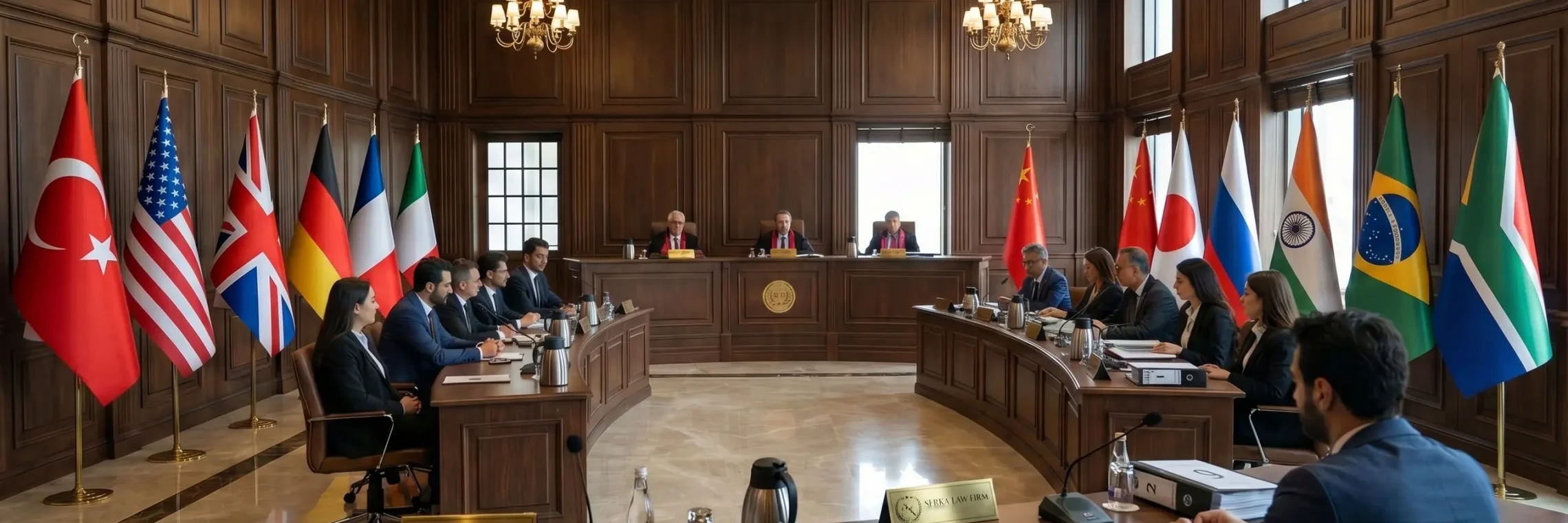
International arbitration is usually the right path for a cross-border commercial dispute when the contract contains a valid arbitration clause and the parties need a neutral forum with an award that is enforceable across borders. For matters with a foreign element seated in Turkey, the framework is International Arbitration Law No. 4686, while domestic arbitration runs under the Code of Civil Procedure No. 6100, and a foreign award is recognized and enforced through the New York Convention 1958 together with the Act on Private International and Procedural Law No. 5718. Serka Law Firm builds and defends that strategy from clause design to award enforcement.
The fixed points an international arbitration lawyer works to in Turkey: Turkey acceded to the New York Convention on 2 July 1992 with two reservations, awards made in another contracting state and commercial relationships only (UNCITRAL status page); a foreign award is enforced on three documents, the arbitration agreement, the award and certified translations (Article 61(1) of Law No. 5718), and six of the nine refusal grounds must be proved by the party resisting enforcement (Article 62(2)). An arbitration clause, even one seating the arbitration abroad, does not stop a Turkish court from ordering a precautionary attachment on the debtor’s assets (Articles 1(3) and 6(1) of Law No. 4686). A clause that names “the Chamber of Commerce and Industry of the Republic of Turkey” names no single institution, since ISTAC, each provincial chamber and TOBB are separate legal persons (Law No. 6570; Law No. 5174, Articles 4, 5 and 54), and that is argued before the merits.
What is international arbitration and when is it the right path?
International arbitration is a private dispute-resolution process in which a neutral tribunal, rather than a national court, decides a commercial dispute and issues a binding award. It is the right path when the contract holds a valid arbitration clause, the parties want a neutral forum away from either side’s home courts, the dispute is genuinely cross-border, or the priority is an award that can be enforced abroad under the New York Convention 1958. Arbitration with a foreign element seated in Turkey is governed by International Arbitration Law No. 4686.
The value of early counsel is not in explaining arbitration theory. It is in deciding whether this dispute should go to arbitration at all, whether the clause is enforceable, and which institution, seat, and governing-law combination best protects commercial exposure. Those choices are easiest to control before notices and pleadings are drafted, because early procedural decisions shape the entire case.
Who needs an international arbitration lawyer?
An international arbitration lawyer is needed by companies, investors, and counterparties whose commercial relationships carry cross-border risk and whose contracts route disputes to arbitration. The work divides into two moments: protecting the position before a dispute exists through clause design, and controlling forum and leverage once a dispute is live. Both turn on the same statutory framework of Law No. 4686, the New York Convention 1958, and Law No. 5718 on enforcement.
- Companies drafting, reviewing, or renegotiating arbitration clauses in cross-border contracts.
- Investors and shareholders preparing for or facing a cross-border commercial dispute.
- Parties already served with a notice of arbitration, a jurisdiction objection, or an emergency application.
- Businesses weighing arbitration against court litigation before they commit to a forum.
- Award creditors and respondents planning recognition, challenge, or enforcement of an award.
What is the legal framework for arbitration connected to Turkey?
Arbitration connected to Turkey runs on a layered framework. International Arbitration Law No. 4686 governs arbitrations that have a foreign element and are seated in Turkey, and it preserves wide party autonomy over clause design, seat, language, and procedure. Purely domestic arbitration is governed by the Code of Civil Procedure No. 6100. Recognition and enforcement of a foreign arbitral award proceeds under the New York Convention on the Recognition and Enforcement of Foreign Arbitral Awards 1958 and the Act on Private International and Procedural Law No. 5718, whose Articles 60 to 63 set out the enforcement route for foreign awards.
A workable clause keeps four questions separate rather than collapsing them into one vague “international arbitration” label: the institution, the seat, the governing law, and the arbitrator-appointment path. ICC and ISTAC are not interchangeable; they carry different procedural rules, emergency tools, cost structures, and case-management expectations. Even where the seat is outside Turkey, a Turkey-linked dispute can still require Turkish-court work for interim relief, evidence pressure, or enforcement against local assets.
ICC or ISTAC: how do the institutions compare?
The choice of institution shapes cost, speed, emergency options, and how an award is later enforced. The International Chamber of Commerce (ICC) is a long-established global institution often chosen for high-value international matters, while the Istanbul Arbitration Centre (ISTAC) is a Turkey-based institution frequently selected where the dispute, the parties, or the assets are closely connected to Turkey. The right answer is dispute-specific, and the same analysis applies when the real question is arbitration versus court litigation.
| Decision point | Typical fit for ICC | Typical fit for ISTAC |
|---|---|---|
| Connection to Turkey | Parties and assets spread across several jurisdictions | Dispute, parties, or assets closely linked to Turkey |
| Profile of the matter | High-value, multi-jurisdiction commercial disputes | Cost-conscious matters with a strong Turkish nexus |
| Procedural toolkit | Established global rules and emergency-arbitrator practice | Local rules with emergency and expedited options |
| Enforcement target | Award to be enforced across multiple countries | Award likely enforced where Turkish assets sit |
Detailed guidance on this choice is set out in the note on ICC versus ISTAC arbitration in Turkey and our overview of international commercial arbitration and enforcement.
How does the arbitration process work?
The arbitration process moves from clause and forum review, through constitution of the tribunal and the exchange of pleadings and evidence, to the hearing, the award, and, where needed, enforcement or challenge. Under International Arbitration Law No. 4686 the parties keep substantial control over procedure, so the file is built deliberately rather than left to a fixed court timetable.
- Review the transaction and dispute architecture. Map the contract stack, the governing-law issues, the dispute scope, and the practical leverage points before any notice is sent.
- Test the clause and forum mechanics. Confirm that the arbitration clause is workable on seat, institution, language, and governing law, because the drafting drives cost, speed, and enforceability.
- Build merits and procedure together. Coordinate document management, witness planning, expert need, and interim-relief posture from the start rather than treating forum and merits as separate problems.
- Manage the proceeding. Structure the case around deadlines, pleadings, evidence, hearing strategy, and negotiation leverage through to the award.
- Plan the post-award stage early. Where enforcement, challenge, or settlement pressure is likely, shape the strategy before the tribunal closes the record.
How is a foreign arbitral award enforced through or against Turkey?
A foreign arbitral award is recognized and enforced in Turkey under the New York Convention 1958 and the Act on Private International and Procedural Law No. 5718, with Articles 60 to 63 governing the enforcement route for foreign awards. Enforcement is not automatic: a Turkish court reviews the award against the limited refusal grounds available under the Convention, such as an invalid arbitration agreement or a public-policy objection, but it does not re-try the merits.
Because enforcement turns on where the losing party holds assets, recovery strategy should be set before the arbitration begins, not after the award is issued. Where assets sit in Turkey, the firm coordinates the recognition action with asset-tracing and interim-protection steps. Our practical guide to this stage is enforcing foreign arbitral awards under the New York Convention.
What documents and evidence does an arbitration file need?
A strong arbitration file links every requested outcome to a fact, every fact to a document, and every procedural step to a deadline. The starting set is the full contract stack and the record of how the relationship broke down, followed by the financial and technical evidence that proves the claim or defense.
- The contract set, amendments, annexes, and the dispute-resolution clauses.
- Correspondence, formal notices, meeting records, and the performance history.
- Invoices, payment history, and the records that quantify damages.
- Technical evidence, industry records, and material that will support expert work.
- Asset and enforcement intelligence wherever recovery risk exists.
What mistakes cause delay or loss in arbitration?
The most damaging mistakes are made at the contract stage, long before a dispute exists. A copied arbitration clause that was never tested for seat, institution, language, and governing-law fit is the single most common source of later procedural fights, and it is precisely the risk that early clause review removes.
- Copying an arbitration clause without testing seat, institution, language, and governing-law fit.
- Assuming arbitration is automatically faster or cheaper than court in every dispute.
- Filing before securing a coherent documentary record.
- Ignoring parallel court, injunction, or enforcement exposure.
- Leaving recovery or resistance strategy until after the award is issued.
The drafting traps that recur in practice are collected in our notes on arbitration clause drafting mistakes and on the difference between the seat and the governing law of an arbitration clause.
Why choose Serka Law Firm for cross-border arbitration?
Serka Law Firm advises companies, investors, and counterparties on commercial arbitration with a cross-border dimension, working in English and the other languages supported across the firm. The practice operates within a defined statutory framework, International Arbitration Law No. 4686, the Code of Civil Procedure No. 6100, the New York Convention 1958, and the Act on Private International and Procedural Law No. 5718, and across the ICC and ISTAC institutional systems. Where a dispute reaches a national court for interim relief or enforcement, the firm keeps the arbitration strategy and the court strategy on a single workstream rather than two disconnected files. For disputes that belong in court, see our work on international commercial litigation and on business disputes.
Frequently asked questions
Is arbitration always better than litigation?
No. The better forum depends on the clause, the counterparty, the urgency, the enforcement goal, the evidence profile, and the cost-to-value ratio of the dispute. Some matters are stronger in court, and the choice is made dispute by dispute rather than as a rule.
What is the most common arbitration mistake before a dispute starts?
A weak or inconsistent arbitration clause. Many later procedural fights are created at the contract stage, not at the claim stage, which is why testing the clause for seat, institution, language, and governing law early is the cheapest protection available.
Should award enforcement be considered before the arbitration begins?
Yes. If recovery is the goal, the enforcement geography and the counterparty’s real assets should shape the strategy from the start. Enforcement of a foreign award proceeds under the New York Convention 1958 and Law No. 5718, and where the assets are determines whether the award is worth pursuing.
Can Serka help if the arbitration is seated outside Turkey?
Yes. A Turkey-linked dispute often needs Turkish-law input, evidence coordination, interim-relief strategy, or later enforcement work even when the seat is elsewhere, and the firm coordinates those steps with the client’s foreign counsel.
What is the difference between the seat and the governing law of an arbitration clause?
The seat sets the procedural law and the supervising courts of the arbitration, while the governing law decides the substance of the contract. Treating them as the same thing is a frequent drafting error, and the two should be chosen separately and on purpose.
Clause, seat and enforcement in one file
The clause, the forum, the interim-relief options and the enforcement path are worked as one file, because a precautionary attachment in Turkey can run beside an arbitration seated abroad.
Related practice areas: corporate and commercial law, international commercial litigation, and business disputes.
General information, not legal advice. Turkish law; verify your specific situation with qualified counsel.