
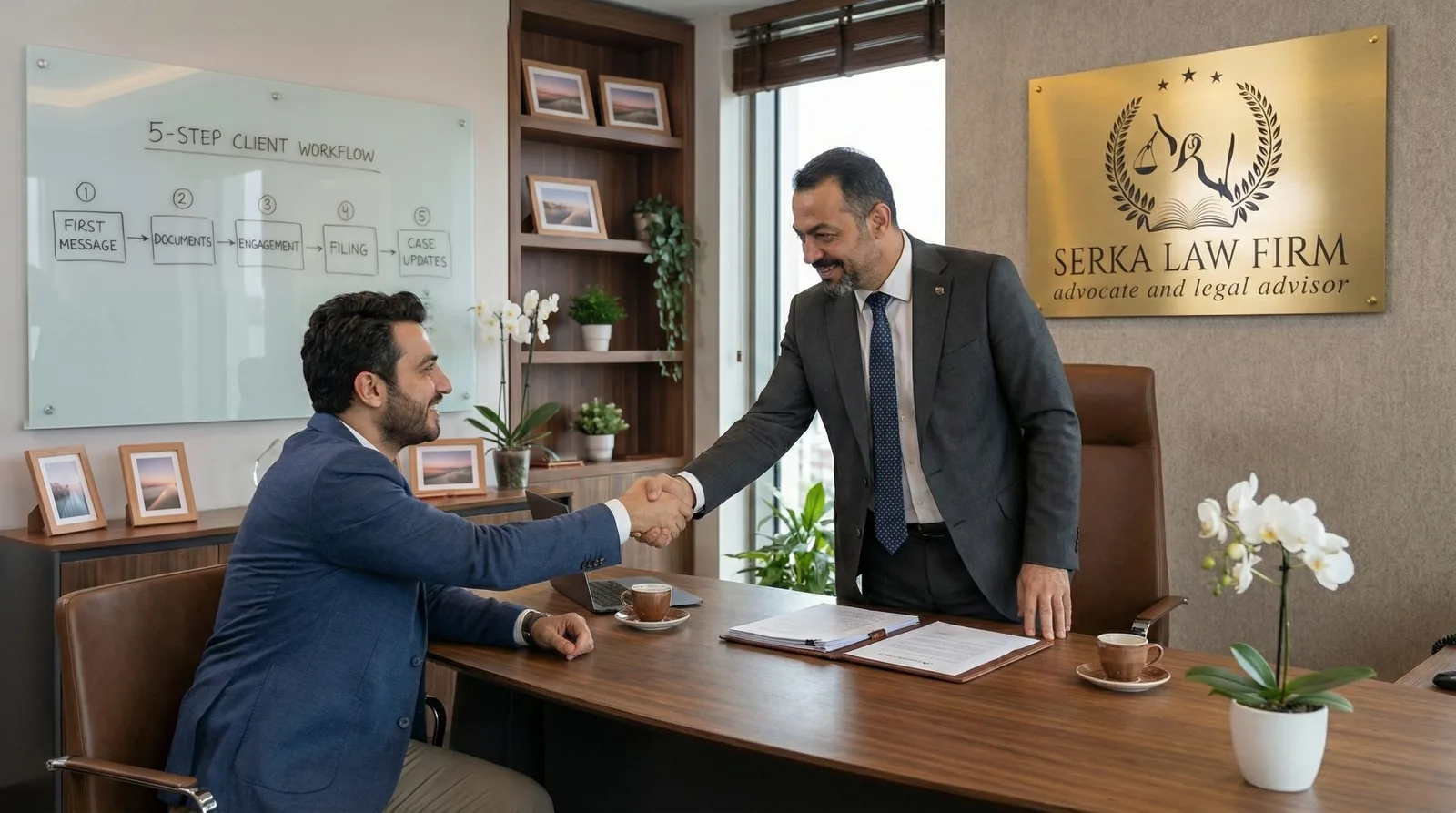
Serka Law Firm is an international, cross-border practice that represents Arabic-speaking clients from the Gulf and the wider Arab world in legal matters wherever they sit, under whichever law governs them. Our lawyers work directly with clients and their advisers in Arabic and English, so that residency, investment, corporate and family files are handled in the language the client actually negotiates in, while the legal work itself is grounded in the law and the authorities that govern each file.
This page describes how the firm serves Arabic-speaking clients. The legal substance below concerns Turkish statutes and procedures, because that is what foreign clients with interests in Turkey usually need. The matters this page covers for Arabic-speaking clients are citizenship by investment, company and free-zone formation, real estate acquisition, asset structuring, residence permits, and cross-border disputes.
What does an Arabic-speaking lawyer in Turkey actually do for you?
An Arabic-speaking lawyer in Turkey lets you instruct counsel in your own language while the firm executes the work under Turkish law. In practice that means we take instructions in Arabic, review your documents and counterparties, identify the correct Turkish legal track, and then handle filings, contracts, registrations and representation before Turkish authorities and courts on your behalf.
For most Arab clients the value is not translation alone. It is having a team that understands both the commercial logic of a Gulf or regional transaction and the procedural reality of Turkish institutions: the Presidency of Migration Management, the Land Registry, the Trade Registry, the Tax Office, and the civil and commercial courts. We coordinate sworn translation and notarisation, apostille and consular legalization of your foreign documents, and powers of attorney drawn so that work can proceed even when you cannot travel.
Which practice areas do Arab clients most often need?
The practice areas Arabic-speaking clients use most are citizenship by investment, real estate acquisition, company formation, asset structuring and immigration. These cluster together because a single investment file usually triggers several of them at once, and treating them as one coordinated matter avoids gaps between them.
Turkish citizenship by investment
Turkish citizenship by investment is governed by the Turkish Citizenship Law (Law No. 5901) and its implementing regulation, which set out qualifying routes such as real estate purchase held for a minimum period, fixed capital investment, bank deposits, and job creation. We confirm the current monetary threshold and holding conditions at the time of filing, structure the purchase or investment to meet them, supervise the valuation and title steps, and manage the exceptional-citizenship application through to the decision. The exact investment amounts and holding periods are set by regulation and are revised periodically, so we verify the figure that applies on your filing date rather than working from a fixed number. See our dedicated page on guide to the amounts and holding periods in force.
Real estate and property acquisition
Property purchase by foreign nationals is the most common entry point and the one with the most hidden risk. Before any payment we run title due diligence at the Land Registry, check for encumbrances, mortgages and annotations, verify zoning and occupancy status, and confirm that the property qualifies for the citizenship route if that is the goal. Our real estate and property acquisition team drafts and reviews the sale contract under the Turkish Code of Obligations (Law No. 6098) and supervises transfer at the registry.
Company formation and corporate structuring
Arab investors frequently set up a Turkish company to hold assets, run an operating business, or anchor a free-zone presence. Company formation is governed by the Turkish Commercial Code (Law No. 6102). We advise on the right vehicle (most often a limited liability company or a joint-stock company), draft the articles, handle Trade Registry registration, and set up the governance and shareholder arrangements. From establishing the company through to its day-to-day legal needs, this runs through our corporate and commercial law practice.
Asset structuring and foreign direct investment
For clients holding assets across more than one country, the question is how Turkish holdings fit into the wider structure. We coordinate ownership, succession exposure and tax treatment so the Turkish piece does not create conflicts elsewhere, and we advise inbound investors on foreign direct investment into Turkey, including how the Turkish vehicle interacts with holdings in the Gulf and beyond.
Immigration, residence and family matters
Residence permits, family reunification and entry questions are governed by the Law on Foreigners and International Protection (Law No. 6458). We handle short-term and family residence permits through our immigration and residence permits team. Cross-border family and inheritance questions, where a marriage, divorce or estate touches more than one jurisdiction, are resolved under the International Private and Procedural Law (Law No. 5718) alongside the Turkish Civil Code (Law No. 4721); see family and divorce matters.
How does the firm handle a cross-border Arabic-speaking file?
We run each file in four stages: scoped intake, document and risk review, execution under Turkish law, and closeout. Intake is in Arabic so nothing is lost in translation; execution and any court or registry step is handled by us so you do not deal with Turkish institutions directly.
At intake we confirm your goal, the decisive document, any live deadline, and the Turkish authority or counterparty that will test the file. We then collect what is needed: passports and identity records, existing contracts or title documents, corporate records for company work, and proof of funds where an investment or citizenship route is involved. Foreign documents are arranged with sworn translation, notarisation and the correct apostille or consular legalization. Where you cannot be present in Turkey, a properly drafted power of attorney lets us act for you, which is normal practice for clients managing a Turkish file from Riyadh, Dubai, Doha, Cairo or Beirut.
How long does it take?
Timing depends on the underlying matter, not on the language of intake: a residence permit, a company formation, a property purchase, a citizenship-by-investment file and a litigated dispute each run on a different timeline.
| Matter type | Typical timeline | Main variables |
|---|---|---|
| Residence permit | Weeks to a few months | Permit category, appointment availability, document completeness |
| Company formation | Days to a few weeks | Vehicle type, shareholder structure, banking onboarding |
| Real estate purchase | Weeks | Title status, valuation, financing, registry workload |
| Citizenship by investment | Several months | Investment route, valuation and holding steps, application processing |
| Cross-border dispute | Several months to longer | Forum, arbitration or court, complexity, enforcement |
Timelines above are general planning indications, not guarantees, because processing times at Turkish authorities vary.
Why do cross-border Arab clients choose this firm?
Clients choose us because they get Arabic-language access to a practice that runs the whole file, not a referral desk that hands the legal work to someone else. The instruction language is Arabic, the legal execution is Turkish, and our team owns both ends.
- Arabic and English working language. You instruct, negotiate and ask questions in Arabic; we translate the legal reality back to you in plain terms.
- One coordinated file. Citizenship, property, company and tax steps are handled together, so the property purchase that underpins a citizenship application is structured correctly from day one.
- Direct representation before Turkish authorities. We act before the Land Registry, Trade Registry, Migration Management and the courts, so you are not navigating institutions in a language you do not use.
- International, not local-only, posture. We are a cross-border practice serving clients across the Arab world, not a location-pitch firm; the work is built around international clients, wherever their interests sit.
What disputes and enforcement issues come up, and how are they handled?
When a Turkish matter turns adversarial, the route depends on the contract and the parties. Commercial contracts with an arbitration clause go to arbitration; others go to the Turkish commercial courts, and unpaid debts go through enforcement proceedings under the Enforcement and Bankruptcy Law (Law No. 2004).
We represent clients in international arbitration and in international commercial litigation, including the recognition and enforcement of foreign judgments and awards in Turkey under Law No. 5718. Where data, technology or privacy issues arise, the Personal Data Protection Law (Law No. 6698) applies, and we advise accordingly.
In which languages does the firm serve Arab clients?
We serve Arabic-speaking clients in Arabic and English, with the legal work conducted under the law that governs each file. Documents originating in Arabic are handled with sworn translation where a Turkish authority requires it, and correspondence with you stays in the language you prefer throughout the matter.
Frequently asked questions
Do I need to be in Turkey to start, or can the work be done remotely?
Most files can start and largely proceed remotely. With a properly drafted power of attorney, prepared and legalized in advance, we can act on your behalf for company formation, property transfer and many application steps without you traveling, which is how most Gulf and regional clients run a Turkish matter.
Will buying property in Turkey give me citizenship?
Property purchase is one qualifying route to Turkish citizenship by investment under Law No. 5901 and its regulation, but only if the property meets the current value threshold, is held for the required period, and the title and valuation steps are done correctly. Not every purchase qualifies, so the structure must be set up for the citizenship goal from the start.
Can you work from documents that are in Arabic?
Yes. We take your core documents as they are and arrange sworn translation, notarisation and apostille or consular legalization where a Turkish authority requires it. Intake does not wait for you to translate everything first.
My matter touches both real estate and immigration. Do I need two firms?
No. We handle linked files as one coordinated matter. A property purchase that supports a residence or citizenship goal is structured so the real estate, immigration and any corporate step stay aligned on evidence, timing and the same set of authorities.
Last updated: 14 June 2026
This page is general information and not legal advice. It does not create an attorney-client relationship, which forms only by a signed engagement. Statutory thresholds and processing times referred to above are set by Turkish law and regulation and change over time; the conditions that apply to your matter are confirmed at the time of filing.