
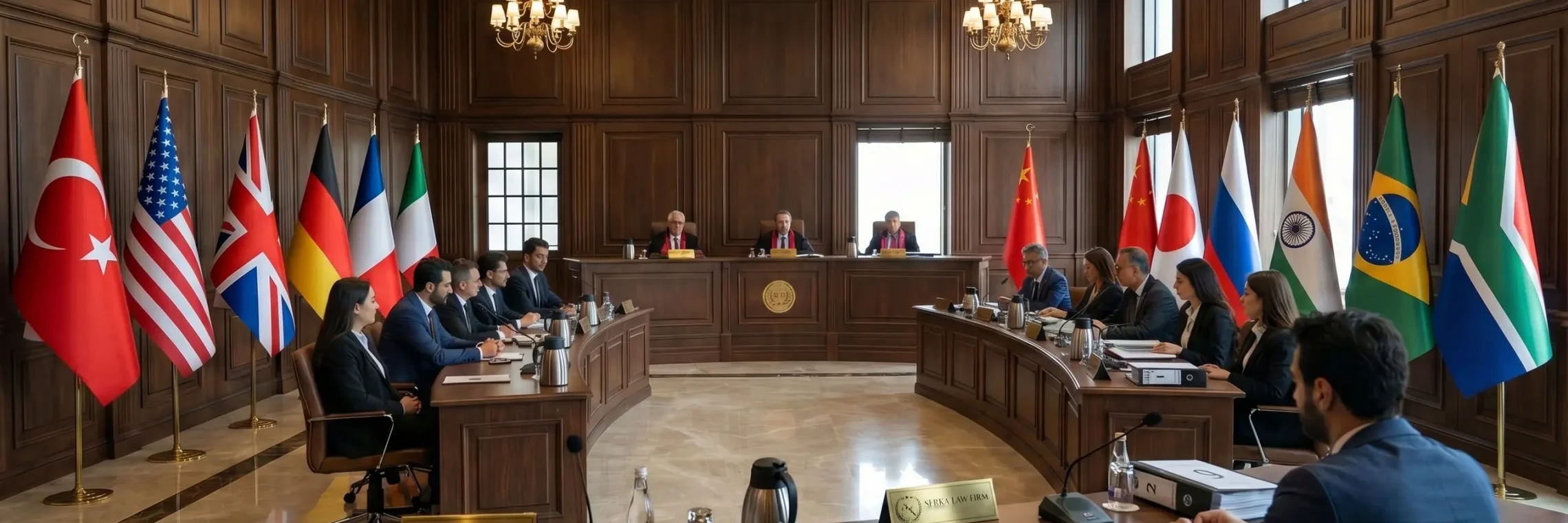
For a Turkey-linked commercial dispute, the choice between the ICC International Court of Arbitration and the Istanbul Arbitration Centre (ISTAC) should be driven by the transaction, not by reputation: both produce awards enforceable under the same legal architecture, namely the International Arbitration Law No. 4686 for awards seated in Turkey and the New York Convention for cross-border recognition, so the decisive factors are cost structure, administration style, language, and where enforcement pressure will fall.
The substantive question is rarely which institution is more famous. It is which institutional framework better fits the contract value, the counterparties, the urgency profile, and the practical role Turkey will play once the dispute is live. Below we set out the comparison the way a foreign investor or general counsel actually needs to weigh it.
What is the difference between ICC and ISTAC arbitration?
The ICC International Court of Arbitration is a Paris-based global institution administering arbitrations worldwide, while ISTAC is the Istanbul Arbitration Centre, a Turkish institution established to administer domestic and international cases with a Turkey-linked footprint. Both administer arbitrations whose awards, when seated in Turkey, fall under the International Arbitration Law No. 4686. The difference is institutional, not jurisdictional: each has its own rules, fee scale, and case-management culture, and the choice between them shapes procedure, cost expectations, and the comfort level of the parties rather than the underlying enforceability of the result.
Which institution should a cross-border company choose?
Choose by mapping the deal, not the logo. Under both the ICC Rules and the ISTAC Rules an award is rendered by a tribunal whose seat determines the supervisory law, so first identify the seat and governing law, then weigh four variables: contract value and the proportionality of administrative fees, the familiarity counterparties and lenders expect, the language posture of the transaction, and the likely enforcement horizon. A globally syndicated deal with foreign lenders often favors the international familiarity of the ICC, while a Turkey-centered transaction with assets and witnesses in Turkey may be more proportionate and procedurally natural under ISTAC. Neither choice is universally correct; the fit follows the facts.
How does institution choice affect cost?
Both institutions publish an administrative fee scale tied to the amount in dispute, plus arbitrator fees, so cost scales with claim size rather than with a flat figure. The ICC and ISTAC each set their own schedules, and the amounts in force change periodically; confirm the current scale in force at the time of filing directly from each institution before committing in the clause. As a practical matter, comparing only the headline filing cost is a recurring mistake. Administration style, the number of arbitrators, hearing logistics, translation needs, and the procedural complexity the case will demand all move the real budget more than the published entry fee.
What documents shape the institution decision?
The forum choice is made on the contract record, not on instinct. Before locking the clause, assemble the documents that reveal what the dispute will actually look like.
- the draft or signed arbitration clause and the seat and governing-law provisions
- the main commercial agreement and any related framework or shareholder agreements
- transaction size, counterparty profile, and the working language of the deal
- any lender, shareholder, or group-policy requirement that constrains forum choice
- early assumptions about where assets, witnesses, and enforcement targets sit
These same documents later drive the procedural strategy, so gathering them at the drafting stage is not wasted effort.
How are ICC and ISTAC awards enforced in Turkey and abroad?
Enforcement runs on the same backbone regardless of which institution administered the case. An award seated in Turkey is governed by the International Arbitration Law No. 4686, while a foreign-seated award is recognized and enforced in Turkey under the New York Convention, with the Code of Civil Procedure No. 6100 and the International Private and Procedural Law No. 5718 supplying the procedural route through the competent court, and the Enforcement and Bankruptcy Law No. 2004 governing the subsequent execution. The New York Convention permits refusal of recognition only on the narrow grounds listed in its Article V, which is why institution choice influences enforcement indirectly: it shapes the quality of the record and the procedural regularity that a resisting party will later test against those grounds.
What are the risks of choosing the wrong forum?
The two recurring failure modes both trace back to drafting under time pressure. The first is selecting an institution because it sounds internationally strong without testing whether that forum matches the transaction, leaving the parties with a clause misaligned to deal size, language, or the realistic urgency of the case. The second is copying an arbitration clause from an old template so that the seat, the institution, and the governing law no longer fit the deal. Because the New York Convention reviews awards only on the limited Article V grounds, a defective clause rarely destroys enforceability outright, but it can raise cost, delay, and the surface area for challenge. The cure is to fix the clause while it is still negotiable rather than to manage the consequences after signature.
ICC vs ISTAC: side-by-side comparison
| Factor | ICC International Court of Arbitration | ISTAC (Istanbul Arbitration Centre) |
|---|---|---|
| Profile | Paris-based global institution with worldwide caseload | Turkish institution with a Turkey-linked footprint |
| Typical fit | Globally syndicated deals; foreign lenders and counterparties expecting international familiarity | Turkey-centered transactions with local assets, witnesses, or counterparties |
| Fee basis | Administrative scale tied to amount in dispute; confirm current scale at filing | Administrative scale tied to amount in dispute; confirm current scale at filing |
| Supervisory law when seated in Turkey | International Arbitration Law No. 4686 | International Arbitration Law No. 4686 |
| Cross-border enforcement | New York Convention, Article V grounds | New York Convention, Article V grounds |
| Language posture | Commonly English; multilingual capacity | Turkish and English both well supported |
Use this grid as a starting filter, then pressure-test the shortlisted institution against the specific clause and counterparty before you commit.
Frequently asked questions
Is ICC always the better choice for cross-border disputes?
No. The ICC International Court of Arbitration is often the stronger fit where foreign lenders and counterparties expect global familiarity, but institutional fit depends on the deal and dispute profile, not on reputation alone. A Turkey-centered transaction with local assets and witnesses can be served well by ISTAC. Both produce awards enforceable abroad under the New York Convention, so the choice turns on cost, language, and case-management fit rather than on which name carries more prestige.
Is ISTAC only suitable for small or domestic cases?
No. ISTAC, the Istanbul Arbitration Centre, administers both domestic and international arbitrations, and a sizable Turkey-linked dispute can fit it well depending on the clause, the counterparties, and the commercial objectives. Awards from ISTAC-administered cases seated in Turkey sit under the International Arbitration Law No. 4686 and are recognized abroad through the New York Convention, the same architecture that supports ICC awards. The deciding factor is alignment with the transaction, not an assumption about case size.
Can the choice of institution affect later enforcement?
Yes, indirectly. Institution choice does not decide enforcement by itself, because recognition under the New York Convention turns on the narrow grounds in its Article V rather than on the administering body. What the institution influences is the quality of the procedural record and the regularity of the process, both of which a resisting party will later test against those Article V grounds. A well-administered case with a clean record is harder to challenge at the enforcement stage in Turkey or in another Convention state.
Can the institution be changed after the contract is signed?
Generally only by agreement. The arbitration clause is a binding agreement between the parties, so changing the named institution after signature ordinarily requires the counterparty to consent to an amendment. If the clause is still under negotiation, this is the moment to align the institution, seat, and governing law. If it is already signed, the realistic step is to assess what practical consequences follow from the chosen institution and manage them within the wider dispute strategy rather than assuming the forum can be swapped unilaterally.
Choose the institution before it is locked in
If forum choice is still open, the highest-value moment to act is now, before the clause is signed and the institution is fixed. Our team advises foreign investors, general counsel, and cross-border companies on choosing between ICC and ISTAC, drafting the arbitration clause, and protecting enforceability under the New York Convention.
For related guidance, see the analysis of common arbitration clause drafting mistakes in Turkey, the difference between the seat and the governing law in an arbitration clause, and the practical steps for enforcing foreign arbitral awards in Turkey under the New York Convention.
General information, not legal advice. Turkish law; verify your specific situation with qualified counsel.