
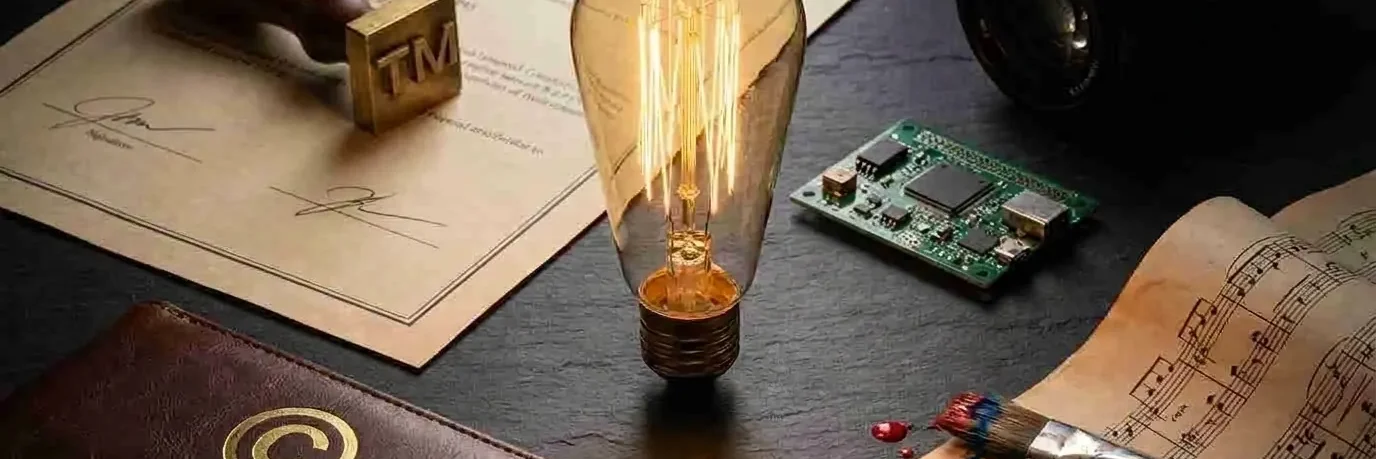
Intellectual property in Turkey is governed by two core statutes: the Industrial Property Law No. 6769, which covers trademarks, patents, utility models, industrial designs, and geographical indications, and the Copyright Law No. 5846, which protects literary, artistic, musical, and audiovisual works. The Turkish Patent and Trademark Office (TURKPATENT) administers industrial property registrations, while copyright arises automatically on creation with no registration required. For foreign businesses, the Madrid Protocol, the Patent Cooperation Treaty (PCT), and the Paris and Berne Conventions extend Turkish rights across borders, so a single coordinated strategy can protect your brand, technology, and creative assets in multiple markets at once.
What law governs intellectual property in Turkey?
Two statutes do the work. The Industrial Property Law No. 6769 governs trademarks, patents, utility models, industrial designs, and geographical indications, all registered through TURKPATENT. The Copyright Law No. 5846 governs original works of science, literature, music, fine art, and film, and protection is automatic from the moment of creation. Turkey is also a member of WIPO and a party to the Paris Convention, the Berne Convention, and the TRIPS Agreement, which align its framework with international standards and let foreign rights holders claim treaty priority and recognition.
For an investor or general counsel, the practical takeaway is that one Turkish filing strategy can interlock with the international system rather than standing alone. If you are setting up operations here, coordinating IP with corporate structure from the start avoids costly gaps later. See the guidance on legal aspects of foreign investment in Turkey.
What types of intellectual property are protected?
Industrial Property Law No. 6769 and Copyright Law No. 5846 together protect seven main categories, each with its own registration rule and term. The table below summarizes the governing law, whether registration is required, the duration of protection, and the registering authority for each right under current Turkish law.
| IP type | Governing law | Registration | Duration | Authority |
|---|---|---|---|---|
| Patents | Law No. 6769 | Mandatory | 20 years from filing | TURKPATENT |
| Utility models | Law No. 6769 | Mandatory | 10 years from filing | TURKPATENT |
| Trademarks | Law No. 6769 | Recommended | 10 years, renewable indefinitely | TURKPATENT |
| Industrial designs | Law No. 6769 | Recommended | 5 years, renewable up to 25 total | TURKPATENT |
| Copyright | Law No. 5846 | Automatic (voluntary record) | Author’s life plus 70 years | Ministry of Culture (voluntary) |
| Geographical indications | Law No. 6769 | Mandatory | Unlimited while conditions met | TURKPATENT |
| Trade secrets | Commercial Code and competition rules | Internal safeguards | Unlimited while secret kept | Not applicable |
Copyright covers works of science and literature, musical compositions and recordings, fine art, and film and audiovisual works including their scripts, soundtracks, and cinematography. Industrial designs protect the ornamental appearance of a product, geographical indications protect goods tied to a specific origin and reputation, and trade secrets protect confidential business information through contracts, employee non-disclosure agreements, and unfair competition provisions rather than registration. For rights tied to creative and media projects, our entertainment law practice handles the overlapping layers across a full production chain.
How does the patent system protect inventions?
Under Industrial Property Law No. 6769, a granted patent gives the inventor exclusive rights for 20 years from the filing date, while a utility model gives 10 years through a faster route without substantive examination. In exchange for exclusivity, the invention is publicly disclosed, which advances the technical field. To be patentable, an invention must be novel, involve an inventive step, and be capable of industrial application.
The application and prosecution path
- Prior art search: a structured review of existing patents and publications to assess novelty and inventive step before filing.
- Drafting: precise claims that define the scope of protection, supported by a detailed description and drawings.
- Filing strategy: the choice between national filing and the international PCT route, plus priority claims and any divisional applications.
- Examination response: addressing TURKPATENT office actions and examiner objections during prosecution.
- Grant and maintenance: paying the periodic maintenance fees that keep the patent in force for its full term.
Protecting an invention across borders
Foreign filing routes let a single invention reach many markets. The Patent Cooperation Treaty (PCT) allows one international application designating its member states and defers the national-phase decisions, the European Patent Convention (EPC) offers a regional route across European Patent Organisation states, and the Paris Convention gives a 12-month priority window to file abroad while keeping the original filing date. Filing fees and the number of designated states are set by the relevant offices and treaties; confirm the amounts in force at the time of filing, since they are reviewed periodically.
How does trademark registration protect a brand?
Trademark registration with TURKPATENT under Law No. 6769 grants exclusive rights for 10 years from the filing date, renewable indefinitely in successive 10-year terms. Registration converts an unprotected sign into an enforceable asset, giving the owner the legal standing to stop infringers, block confusingly similar later marks, and license or assign the brand. Goods and services are specified using the Nice Classification system.
The registration path is structured and predictable:
- Clearance search: checking existing registrations and applications to surface conflicts before filing.
- Filing: submitting the application with the mark and its goods and services classes.
- Examination: TURKPATENT review on absolute and relative grounds for refusal.
- Publication and opposition: a two-month window in which third parties may oppose based on prior rights.
- Registration: issuance of the registered mark once any opposition is cleared, with protection running from the filing date.
For cross-border brands, the Madrid Protocol lets a trademark holder file one international application through TURKPATENT and designate protection in many member countries at once, which is far more efficient than separate national filings in each market.
How should you enforce and defend IP rights?
Industrial Property Law No. 6769 provides a layered enforcement toolkit, from a cease-and-desist letter through to criminal prosecution, which under the statute can carry imprisonment of up to four years for counterfeiting and deliberate infringement. Because IP value depends on exclusivity, prompt and decisive action matters: the right first move often resolves a dispute before it reaches full litigation.
- Cease-and-desist letter: a formal demand to stop unauthorized use, which frequently ends a dispute early.
- Preliminary injunction: a court order to halt infringing activity while the case proceeds.
- Civil litigation: a lawsuit seeking damages, destruction of infringing goods, and publication of the judgment.
- Criminal prosecution: penalties for counterfeiting and deliberate infringement, including imprisonment up to four years under Law No. 6769.
- Border seizure: customs detention of suspected counterfeit goods on application by the rights holder.
- Mediation: a cost-effective route to resolve commercial IP disputes without court proceedings.
Beyond reacting to infringement, a durable IP program is proactive: regular IP audits to find unprotected or expiring assets, valuation for financing and M&A, licensing structures that earn revenue while keeping control, technology transfer agreements, and ongoing portfolio renewal management.
What is the difference between a patent and a utility model?
Both are granted by TURKPATENT under Law No. 6769, but they trade strength for speed. A patent protects a novel invention for 20 years and requires substantive examination of novelty, inventive step, and industrial applicability, which makes it the stronger right for groundbreaking technology. A utility model protects for 10 years through a faster registration without substantive examination, which suits incremental or simpler technical improvements where speed and lower cost matter more than maximum scope.
| Feature | Patent | Utility model |
|---|---|---|
| Term | 20 years from filing | 10 years from filing |
| Examination | Substantive (novelty, inventive step, applicability) | No substantive examination |
| Best for | Major, complex inventions | Incremental technical improvements |
| Relative speed and cost | Slower, higher | Faster, lower |
How does IP protection work for technology companies and software?
Software is protected by layering several rights rather than relying on one. Under Copyright Law No. 5846, source code is automatically protected as a literary work from the moment it is written. Under Industrial Property Law No. 6769, a novel technical process implemented in software may be patentable, product names and logos can be registered as trademarks, and proprietary algorithms and methodologies are kept as trade secrets through contracts and confidentiality controls. The strongest technology strategy combines all of these, and for data-driven products it must sit alongside data protection compliance.
For technology ventures, IP and privacy obligations run together, since the same product can hold both copyrighted code and regulated personal data under the Law on the Protection of Personal Data No. 6698 (KVKK). See our KVKK data privacy guide for how those duties interact, and our AI legal analysis resource for emerging questions in automated and AI-driven products.
What role does IP play in corporate transactions?
In mergers, acquisitions, and joint ventures, intellectual property is often the core asset being bought, and IP due diligence is now a standard part of corporate and commercial deal planning. The review confirms ownership and chain of title, checks registration status, scope, and remaining term, examines existing licenses and encumbrances, surfaces any pending or threatened infringement disputes, and verifies that employees and contractors have validly assigned their IP. Weaknesses found here directly affect deal value and the warranties a buyer will require.
Frequently asked questions about intellectual property in Turkey
Do I need to register copyright for it to be protected?
No. Under Copyright Law No. 5846, copyright protection arises automatically when an original work is created, with no registration required. A voluntary record with the Ministry of Culture is still useful, because it strengthens your evidentiary position in an infringement dispute and makes enforcement easier to prove. Registration is therefore optional but practical, especially for works with significant commercial value.
How long does trademark registration take?
Trademark registration through TURKPATENT involves filing, examination, a two-month publication period for oppositions, and final registration. Timelines and official fees depend on the number of classes and whether an opposition is filed, so confirm the current figures with TURKPATENT at the time of filing. International protection across many member countries is available through a single Madrid Protocol application, which avoids separate national filings.
Can I protect my IP internationally from Turkey?
Yes, through the treaty system. The Madrid Protocol enables international trademark registration across member countries from one application, the Patent Cooperation Treaty (PCT) provides a unified international patent filing route, and the Berne Convention gives automatic copyright recognition across member states with no formal registration. The right combination depends on your target markets, which should be chosen as part of a coordinated cross-border strategy.
What should I do if someone infringes my IP?
Start with a cease-and-desist letter, which often resolves the matter quickly. If the infringement continues, you can seek a preliminary injunction for immediate relief, bring civil litigation for damages and destruction of goods, and pursue criminal prosecution for deliberate counterfeiting, which can carry imprisonment up to four years under Law No. 6769. Customs border seizure can also intercept counterfeit goods. The best mix depends on the scale of the infringement and your commercial goals.
How are trade secrets protected without registration?
Trade secrets are not registered. They are protected by keeping the information confidential and backing that up with contracts, including employee and contractor non-disclosure agreements, access controls, and unfair competition provisions under the Turkish Commercial Code No. 6102 and competition rules. Protection lasts only while the information genuinely stays secret, so the safeguards a company puts in place are what give the right its value.
Work with Serka Law on your IP strategy
Serka Law Firm advises businesses and individuals on the full intellectual property lifecycle: trademark and patent registration, portfolio management, copyright and design protection, trade secret programs, IP due diligence for M&A, domain and online brand protection, and IP litigation and dispute resolution. Because technology, data, and IP overlap, our work connects directly with privacy and digital-asset compliance. To protect your innovations and brand across borders, talk to our technology, data privacy, and crypto law team and explore the international arbitration route for cross-border IP and licensing disputes.
General information, not legal advice. Turkish law; verify your specific situation with qualified counsel.