
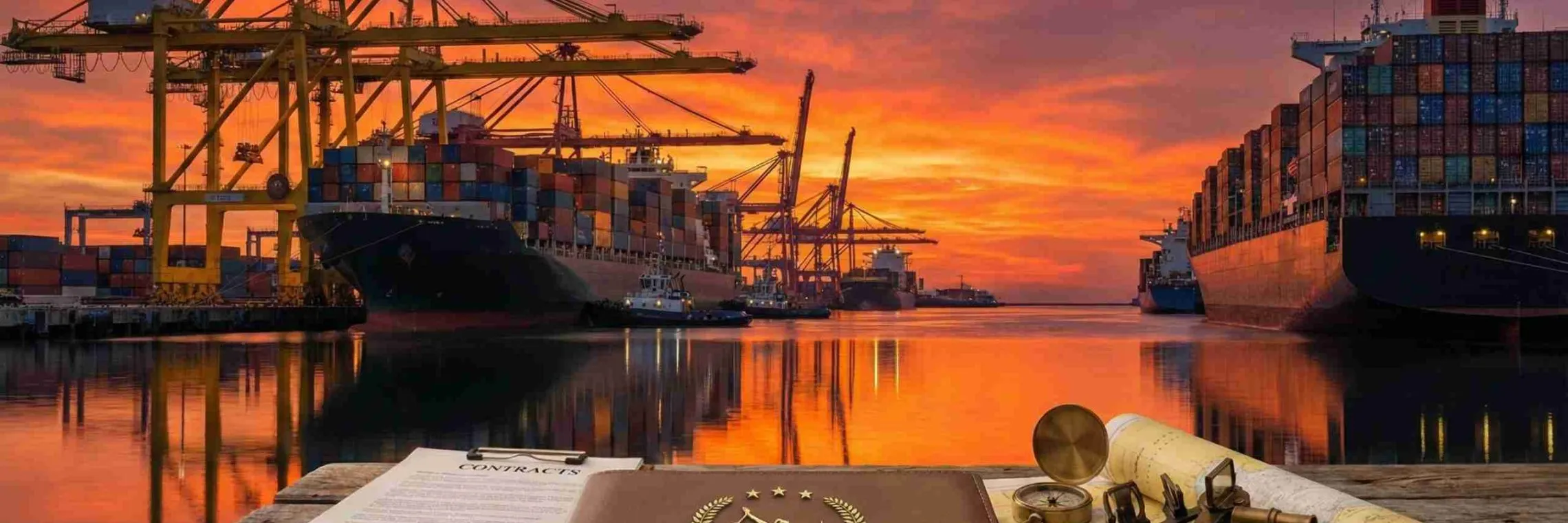
Serka Law Firm represents shipowners, charterers, cargo interests, freight forwarders, traders and their insurers in maritime trade and transport disputes connected to Turkey. The practice covers contracts of carriage, charterparties, cargo claims, vessel arrest, freight and demurrage recovery, and the enforcement of judgments and arbitral awards against ships, bunkers and trading counterparties. We act on cross-border files where the cargo, the vessel, the parties or the security sit in different jurisdictions.
What is maritime trade and transport law?
Maritime trade and transport law governs the commercial relationships that move goods by sea and by connected land carriage: who carries the cargo, on what terms, who bears the loss when something goes wrong, and how a claimant secures payment. In Turkey the core source is the maritime book of the Turkish Commercial Code No. 6102, supported by the Turkish Code of Obligations No. 6098 for general contract and tort questions, and by international conventions where they apply to a given carriage.
This is a commercial, transactional and litigation practice. It is distinct from public maritime regulation. For a wider country overview of the Turkish maritime regime, see our international commercial litigation and international arbitration services.
What does a maritime and transport lawyer actually handle?
A maritime and transport lawyer handles the documents and money that control a shipping dispute: the bill of lading, the charterparty, the cargo survey, the insurance file and the security over the ship. The work splits into contract drafting and dispute resolution, with vessel arrest used as the practical tool to obtain security.
- Carriage of goods and bills of lading. Sea waybills, straight and order bills of lading, delivery against letters of indemnity, title and misdelivery questions, and Hague-Visby allocation of carrier liability.
- Charterparties. Voyage, time and bareboat charters, laytime and demurrage calculation, off-hire disputes, safe-port and seaworthiness obligations, and incorporation of arbitration clauses into bills of lading.
- Cargo claims. Damage, shortage, contamination and delay, survey coordination, time-bar protection and recovery against carrier, terminal or insurer.
- Vessel arrest and security. Conservatory arrest of a ship for a maritime claim, counter-security, release against guarantee, and arrest of sister or bunker assets.
- Freight, demurrage and bunker recovery. Debt recovery against owners, charterers, traders and suppliers, including enforcement on Turkish-connected assets.
- Marine insurance and P&I. Hull and machinery, cargo and protection and indemnity (P&I) club coordination, subrogated recovery and letters of undertaking.
What is the legal basis for maritime claims in Turkey?
The legal basis for maritime claims in Turkey is the maritime book of the Turkish Commercial Code No. 6102, which regulates the ship, the carriage of goods by sea, charterparties, bills of lading, maritime liens, general average and limitation of liability. The Code’s carriage rules are aligned in substance with the Hague-Visby Rules, so the allocation of risk between carrier and cargo is familiar to international parties.
The framework draws on several layers:
| Instrument | What it governs |
|---|---|
| Turkish Commercial Code No. 6102 (maritime book) | Ship, carriage of goods by sea, charterparties, bills of lading, maritime liens, general average, limitation of liability |
| Turkish Code of Obligations No. 6098 | General contract formation, breach, tort and damages |
| Law No. 5718 on Private International Law and International Civil Procedure | Jurisdiction, applicable law, recognition and enforcement of foreign judgments |
| Enforcement and Bankruptcy Law No. 2004 | Conservatory attachment, execution and enforcement against assets |
| International Convention Relating to the Arrest of Sea-Going Ships 1952 (Arrest Convention) | Grounds and procedure for arresting a vessel for a maritime claim |
| New York Convention 1958 | Recognition and enforcement of foreign arbitral awards in Turkey |
Many bills of lading and charterparties choose English law and London arbitration, or another foreign forum. Turkish law still matters whenever the vessel calls at a Turkish port, the cargo is delivered in Turkey, or the only realistic security or enforcement target is connected to Turkey. We coordinate Turkish-law security and enforcement alongside the contractual forum.
How does vessel arrest work in Turkey?
Vessel arrest in Turkey is a conservatory measure that detains a ship to secure a maritime claim while the underlying dispute is decided. The claimant applies to the competent court, shows a maritime claim and a link to the vessel, and the court orders arrest, usually against counter-security. The arrest holds the ship in port until the owner posts an acceptable guarantee or the claim is resolved.
Key practical points:
- Eligible claims. Arrest is available for recognized maritime claims such as cargo damage, unpaid freight, demurrage, bunker supply, collision, salvage and crew wages, in line with the Arrest Convention 1952.
- Speed. A vessel does not stay long. The arrest petition, supporting documents and security must be ready before the ship sails, often within hours of berthing.
- Counter-security. The court ordinarily requires the arresting party to post security to cover wrongful-arrest damages.
- Release. The owner typically secures release by providing a P&I club letter of undertaking or a bank guarantee acceptable to the claimant or the court.
- Sister and associated ships. Arrest of a sister ship in the same ownership may be available depending on the claim and the corporate structure.
What is the timeline of a maritime dispute?
A maritime dispute moves on two clocks: the operational clock, measured in hours when a vessel is in port, and the procedural clock, measured in months once a claim is filed. Evidence preservation happens immediately; arrest happens within the port call; the merits resolve over a longer arbitration or court timeline.
- Hours to days. Preserve evidence, appoint a surveyor, issue protective notices to carrier and insurer, and prepare any arrest application before the ship leaves.
- Days to weeks. Obtain the arrest order, negotiate security or a letter of undertaking, and confirm the dispute forum under the contract.
- Months. Pursue the merits through Turkish court proceedings, foreign litigation or arbitration, depending on the jurisdiction and arbitration clause.
- After judgment or award. Enforce a Turkish judgment directly, or recognize and enforce a foreign judgment under Law No. 5718, or a foreign arbitral award under the New York Convention 1958.
Time bars are unforgiving. Cargo claims under the carriage regime are subject to short limitation periods, and missing a contractual notice deadline can defeat an otherwise good claim. The notice and limitation position should be checked on day one.
Which courts and forums hear maritime disputes?
Maritime disputes are heard by the forum chosen in the contract, by Turkish commercial courts when Turkish jurisdiction applies, or by arbitration when the charterparty or bill of lading contains an arbitration clause. Many shipping contracts select London or another seat, so the first task is to read the jurisdiction and arbitration clauses before any step is taken.
Where Turkish jurisdiction is engaged, specialized commercial courts handle maritime files and apply the Turkish Commercial Code. Where the contract points abroad, we protect the Turkish-side position through arrest and security and then coordinate with the contractual forum. A claim filed in the wrong forum can lose both time and the chance of real recovery, so forum analysis precedes filing.
What documents are needed to start a maritime claim?
A maritime claim starts with the transport and security documents that prove the contract, the loss and the route to recovery. The file should be narrow and decisive rather than a large archive. The following documents control most cargo and charter disputes:
- Bill of lading, sea waybill or delivery order, and the underlying charterparty or transport contract
- Booking notes, mate’s receipts, loading, stowage and delivery records
- Independent survey report, cargo photographs and a quantified loss calculation
- Marine insurance policy, claims correspondence and any subrogation receipt
- Statement of facts, laytime and demurrage calculation for charter disputes
- Notices of claim, protests, emails, invoices and proof of payment or non-payment
- Vessel particulars and ownership records where arrest is contemplated
Foreign-language documents intended for a Turkish court or registry generally require certified translation, and foreign public documents usually require an apostille. Identifying missing records honestly before filing prevents a weak claim from being started prematurely.
How much does a maritime law matter cost?
What a maritime file costs is driven by its stage: vessel arrest, contested litigation and arbitration involve court fees, counter-security, surveyor costs and a longer procedure.
These are paid to the court and to the surveyor; counsel’s own fee is agreed in the engagement agreement (Article 163 of Attorneyship Law no. 1136) and cannot fall below the minimum-fee tariff of the Union of Turkish Bar Associations (Articles 164 and 168). Urgent arrest work is handled on an expedited basis because of the time pressure of a port call.
What are the main risks in a cross-border maritime claim?
The main risk in a cross-border maritime claim is losing security, evidence or time before the legal merits are ever decided. A claim can be technically sound and still recover nothing if the vessel sailed, the cargo was disposed of, or the time bar expired. Risk control means acting on the operational clock, not the litigation clock.
- Lost security. The vessel leaves Turkish waters before an arrest is obtained, removing the most effective enforcement asset.
- Spoiled evidence. Damaged cargo is repaired, sold or moved before an independent survey fixes the condition and the quantum.
- Missed notice or time bar. A short contractual notice period or the carriage limitation period passes unnoticed.
- Wrong forum. A claim is filed where no realistic recovery exists, ignoring the jurisdiction or arbitration clause.
- Misaligned insurance. The claim presented to underwriters does not match the transport record, giving the insurer a coverage defense.
Do I need a lawyer for a maritime trade dispute?
You need a lawyer for a maritime trade dispute whenever security, a time bar, or a foreign forum is in play, which covers almost every contested cargo or charter file. The combination of short deadlines, vessel mobility and cross-border enforcement makes early legal handling decisive. A routine, uncontested freight payment may not need litigation counsel, but it still benefits from a documented demand that preserves the right to escalate.
For files that overlap with company, investment, tax or insolvency questions, we coordinate with our corporate and commercial law, business disputes and debt collection and enforcement teams so the maritime claim sits inside a single, consistent recovery strategy.
Frequently asked questions
Can a foreign company arrest a ship in a Turkish port?
Yes. A foreign claimant with a recognized maritime claim can apply to the competent Turkish court to arrest a vessel calling at a Turkish port, subject to showing the claim and posting counter-security. Because port calls are short, the application and supporting documents should be prepared before the vessel berths so the arrest can be filed without delay.
Which law applies if my bill of lading chooses English law?
If the bill of lading or charterparty chooses English law and arbitration, that choice generally governs the merits of the dispute. Turkish law still applies to procedural steps taken in Turkey, such as vessel arrest and the enforcement of any resulting award. We coordinate the Turkish security and enforcement position alongside the contractual forum.
How long do I have to bring a cargo claim?
Cargo claims under the carriage of goods regime are subject to short limitation periods, and many contracts add even shorter notice deadlines for damage or shortage. Because the exact period depends on the contract and the applicable rules, the limitation and notice position should be confirmed at the start of the file rather than assumed.
What is a P&I club letter of undertaking?
A protection and indemnity club letter of undertaking is a written guarantee from the shipowner’s mutual insurer to pay a claim up to a stated amount, given to obtain release of an arrested vessel. It lets the ship sail while preserving the claimant’s security, and it is usually faster to agree than a bank guarantee.
Can a foreign judgment or arbitral award be enforced against assets in Turkey?
Yes. A foreign court judgment can be recognized and enforced in Turkey under Law No. 5718 on Private International Law and International Civil Procedure, and a foreign arbitral award can be enforced under the New York Convention 1958, to which Turkey is a party. Enforcement still requires a Turkish court procedure and an identifiable asset, such as a vessel, bunkers or a bank account.
Before the vessel sails
Send us the transport documents, the cargo or charter timeline, any survey and insurance records, and the port call that creates urgency. A vessel can be arrested only while it is within Turkish jurisdiction, so the departure date comes first: WhatsApp +90 530 127 59 35, e-mail info@serkalaw.com.
This page is general information, not legal advice. An attorney-client relationship is formed only by a signed engagement. Outcomes depend on the facts of each matter and the applicable law and contracts.