
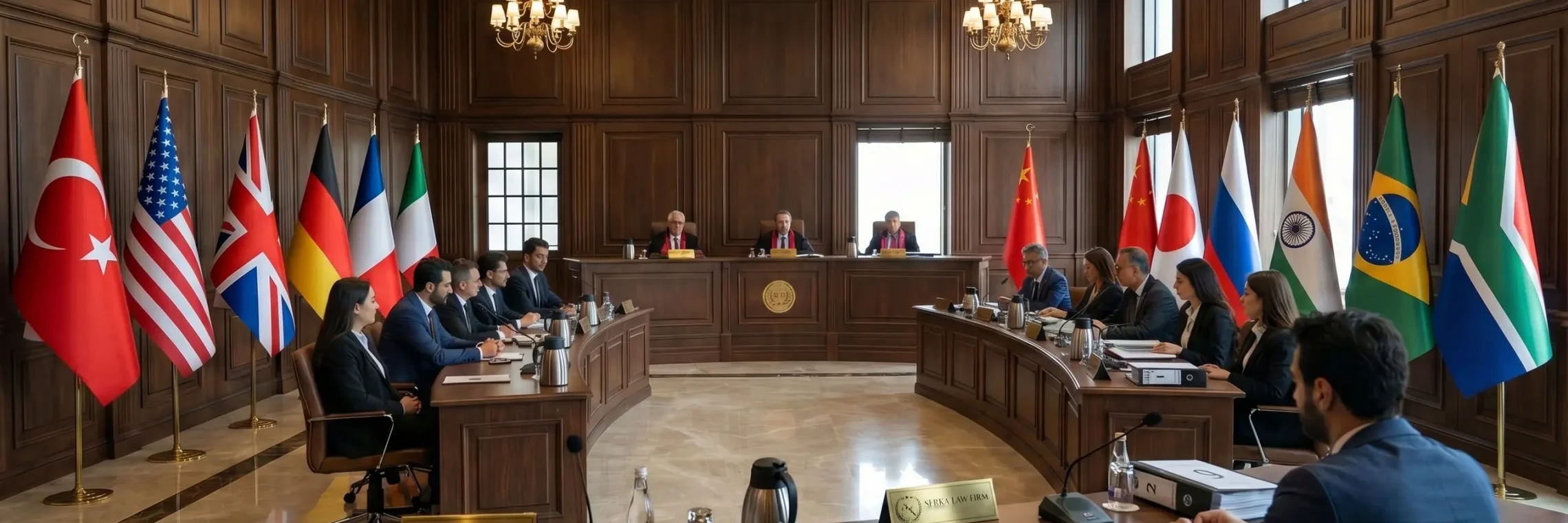
The seat of arbitration and the governing law of a contract are two separate legal choices: the seat fixes the procedural law and the supervising courts of the arbitration, while the governing law decides the substantive rights under the contract. When an arbitration with a foreign element has its seat in Turkey, International Arbitration Law No. 4686 sets the procedural framework (Article 1), and the tribunal decides the merits under the rules of law the parties chose or, failing a choice, under the substantive law of the state most closely connected with the dispute (Article 12(C)). Treating these as one idea is the single most common drafting error that turns a clean commercial deal into a jurisdiction fight before the merits are ever heard.
Serka Law Firm drafts these clauses and acts in arbitrations wherever they are seated, through its international arbitration practice; send the clause or the contract on WhatsApp at +90 530 127 59 35 or to info@serkalaw.com.
What is the difference between the seat and the governing law of an arbitration clause?
The seat (also called the legal place of arbitration) determines the procedural law of the arbitration and which national courts supervise it, set aside the award, or grant interim relief; in a Turkey-seated arbitration that supervising regime is International Arbitration Law No. 4686. The governing law is the substantive law applied to the contract itself: in a Turkey-seated international arbitration the tribunal applies the rules of law the parties chose (Article 12(C) of Law No. 4686), and a Turkish court deciding the contract reads the same choice under Article 24 of Private International Law No. 5718. They are independent: parties can agree English governing law with a seat in Turkey, or Turkish governing law with a seat abroad. The seat is a legal concept, not a travel address, and it is not changed by where hearings physically take place.
Why do parties confuse seat, governing law, and the institution?
The confusion comes from collapsing three distinct decisions into one sentence under signing pressure. Clauses are usually finalized at the end of a negotiation, when the parties are focused on closing the commercial deal rather than designing a dispute mechanism. The result is borrowed wording lifted from another jurisdiction, hybrid language that mixes litigation and arbitration, or an institution named without the surrounding legal structure. A clause that names a city, an institution, and a governing law in one breath can still leave open which court has authority, which rules run the arbitration, and how the clause should be interpreted when a party resists.
What does a well-structured arbitration clause actually specify?
A coherent arbitration clause makes each concept do one job, expressly and separately. It should name the seat, the governing law of the contract, the administering institution and its rules, the language and the number of arbitrators, and the scope of disputes covered. A clause administered by the ICC runs under the ICC Rules of Arbitration; an ISTAC clause runs under the Istanbul Arbitration Centre Rules; an ad hoc clause often adopts the UNCITRAL Arbitration Rules. Naming an institution without adopting its rules, or naming rules without a seat, leaves a gap a hostile counterparty will test. Read every clause as if the other side will exploit each ambiguity, because in a dispute they will.
How do seat and governing law affect enforcing the award?
The seat decides where the award is treated as made, which controls set-aside proceedings and, critically, recognition and enforcement abroad. Cross-border enforcement runs through the Convention on the Recognition and Enforcement of Foreign Arbitral Awards (the New York Convention), to which Turkey is a party. Under Article V of the New York Convention, an award can be refused recognition where the arbitration agreement is invalid under the law the parties chose or, failing that, the law of the seat, or where the tribunal exceeded the scope of the submission. A clause that is vague about seat or governing law widens exactly these refusal grounds. In Turkey a foreign award is first declared enforceable (tenfiz) by the court of first instance, on a petition under Articles 60 to 63 of Law No. 5718: the court the parties agreed in writing or, failing that, the court of the losing party’s domicile, residence or assets in Turkey (Article 60(2)), with the grounds of refusal listed in Article 62. Once the exequatur decision is given, the award is executed like a judgment of a Turkish court (Articles 61(2) and 57(1)), through the enforcement offices under the Enforcement and Bankruptcy Law No. 2004.
Seat versus governing law: a side-by-side comparison
| Question | Seat of arbitration | Governing law of the contract |
|---|---|---|
| What it controls | Procedural law of the arbitration and the supervising courts | Substantive rights and obligations under the contract |
| Typical Turkish anchor | International Arbitration Law No. 4686 (Turkey-seated), Article 9 | Party choice applied by the tribunal under Article 12(C) of Law No. 4686, and by a Turkish court under Article 24 of Law No. 5718 |
| Effect on the award | Fixes where the award is made and where it can be set aside | Decides who wins on the merits |
| Enforcement link | Drives recognition abroad under the New York Convention | Tested under Article V if the agreement is challenged |
| Changed by hearing location? | No, it is a legal designation | No, it is the parties’ express choice |
What should you do with a clause that is already signed or still in draft?
If the clause is still unsigned, fix it now: separate the seat, the governing law, and the institution into distinct provisions, adopt a named rule set, and remove any parallel reference to ordinary courts that contradicts the agreement to arbitrate. If the clause is already signed, the task is risk mapping rather than wishful interpretation. The questions become what can be argued, what a tribunal or court is likely to uphold, and where procedural friction will surface first. For Turkey-linked contracts this assessment is read against International Arbitration Law No. 4686 and Private International Law No. 5718, and it should be done before a dispute crystallizes, not after a notice of arbitration arrives.
Which documents should you assemble before a clause review?
A focused review separates what is already documented from what still needs to be proven. For a seat, governing law, and arbitration-clause assessment, gather the following:
- the draft or signed arbitration clause itself, in its final executed form
- the main contract and its governing-law and dispute-resolution provisions
- any side letters, term sheets, or negotiation drafts that affect the forum wording
- the institution reference and the rule set actually named, if any
- facts showing where the dispute and the enforcement risk are likely to concentrate
- for cross-border matters, powers of attorney, certified translations, and apostille or consular legalization of foreign documents
Does a seat outside Turkey stop a Turkish court from freezing the debtor’s assets?
No. Articles 5 and 6 of International Arbitration Law No. 4686 apply even where the arbitration is seated outside Turkey (Article 1(3)), so a party may ask a Turkish court for an interim measure or a precautionary attachment before or during the arbitration without breaching the clause (Article 6(1)), and its rights under the Code of Civil Procedure and the Enforcement and Bankruptcy Law are preserved (Article 6(4)). The tribunal itself cannot order a measure that the enforcement offices must carry out or that binds a third party such as a bank (Article 6(2) and 6(3)), which is why a freeze on a Turkish bank account is always the court’s. A court-ordered measure falls away by itself once the award becomes enforceable or the claim is dismissed (Article 6(5)).
A clause that names “the Chamber of Commerce and Industry of the Republic of Turkey” names no single institution. The Istanbul Arbitration Centre (ISTAC) is a legal person of private law with its own national and international divisions (Articles 1 to 3 of Law No. 6570), each chamber of commerce is a separate legal person established per province (Articles 4 and 5 of Law No. 5174), and the Union of Chambers and Commodity Exchanges (TOBB) is a union, not a chamber (Article 54), so which body the clause means is argued before anything on the merits.
Frequently asked questions
Does the governing law of the contract automatically decide the seat?
No. The governing law and the seat are independent choices and should never be assumed to collapse into one answer. Parties can validly select one law to govern the substance of the contract and a different legal place as the seat. Under Article 12(C) of International Arbitration Law No. 4686 the tribunal applies the rules of law the parties chose for the merits, while under Article 9 the seat is a separate choice, made by the parties or their institution and, failing that, fixed by the tribunal; the choice of substantive law does not by itself fix the seat.
Is naming a city in the clause enough?
Not on its own. Naming a city can indicate the intended seat, but the clause still needs coherent wording around the institution, the applicable rules, the scope of arbitrable disputes, and the governing law. A bare city reference can leave open whether that city is the legal seat or merely a hearing venue, which are different concepts. Ambiguity here is exactly what a resisting party uses to argue that the agreement is defective.
Can a badly drafted arbitration clause still be used?
Sometimes yes, but the cost of ambiguity surfaces as jurisdiction disputes, set-aside arguments, and delay before the merits are ever heard. A defective clause can also widen the refusal grounds under Article V of the New York Convention when the award is later taken abroad for enforcement. Where the clause can still be revised, correcting it now is far cheaper than litigating its meaning later.
Does the seat change if hearings are held in another country?
No. The seat is a legal designation that stays fixed regardless of where hearings physically occur. Tribunals routinely hold hearings or take evidence in convenient locations without moving the seat. The supervising courts, the set-aside regime, and the procedural law remain those of the agreed seat, which for a Turkey-seated arbitration means the framework of International Arbitration Law No. 4686.
Where the right structure pays off
Getting the seat, governing law, and institution right at the drafting stage is what makes an award enforceable and a dispute manageable. Our team structures and stress-tests cross-border clauses, maps the risk in clauses already signed, and coordinates Turkish-law steps with foreign counsel. Send us the clause and the contract’s governing-law article before it is tested, by e-mail to info@serkalaw.com or on WhatsApp to +90 530 127 59 35; the wider practice is under international arbitration legal services.
For related drafting and enforcement issues, read our guides on common arbitration clause drafting mistakes, choosing between ICC and ISTAC arbitration, and enforcing foreign arbitral awards under the New York Convention.
General information, not legal advice. Turkish law; verify your specific situation with qualified counsel.